




Whenever a new condominium tower, subdivision or hotel is announced in San Carlos, one question inevitably comes up: Where is all the water going to come from?
It’s a reasonable concern in a region where residents periodically experience low water pressure, service interruptions and restrictions, even as new development continues.
San Carlos, Guaymas and Empalme rely on a network of groundwater wells, aqueducts, pumping stations, storage tanks and distribution pipelines. The region also has an operating seawater desalination plant intended to supplement traditional water sources.
So where does our water actually come from? Is the desalination plant working? Why do shortages persist? And is the government ensuring that the water supply can keep pace with San Carlos’ continued growth?
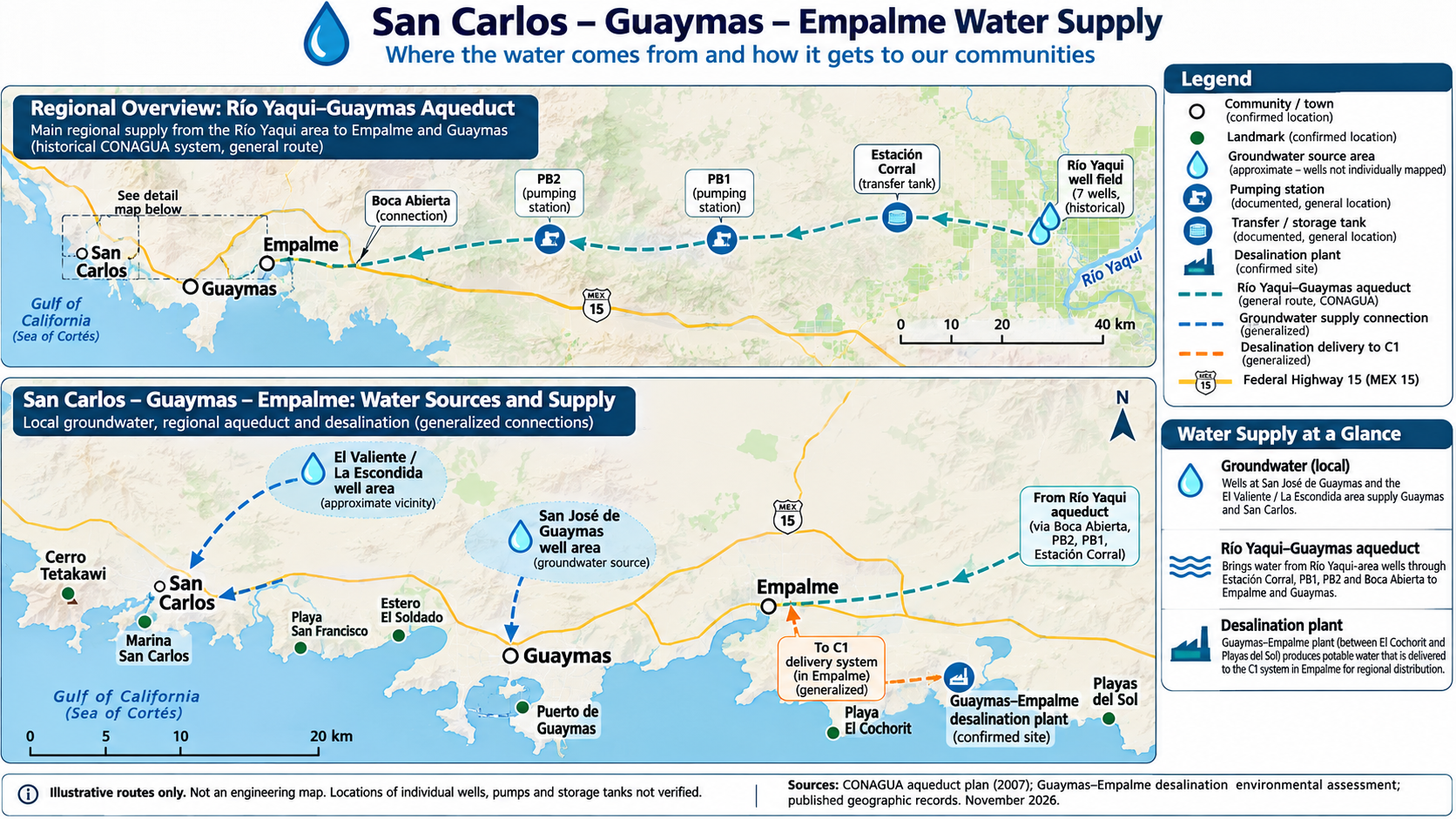
Water supply systems serving San Carlos, Guaymas and Empalme. The map shows documented source areas and approximate connections, with familiar landmarks for orientation. It is an illustrative overview, not an engineering map. Research reviewed November 2026.
Where Does San Carlos Get Its Water?
San Carlos relies heavily on groundwater drawn from wells in the San José de Guaymas area, with water transported through pumping stations, transmission pipelines and storage facilities before reaching homes and businesses.
Among the wells serving the area are El Valiente and La Escondida. Their importance became particularly evident in September 2026, when heavy rains damaged the pumping motor at El Valiente and electrical equipment at La Escondida.
According to CEA information reported by El Vigía on September 25, the failures temporarily interrupted service in Santa Clara and reduced water pressure in parts of San Carlos. Flooded access roads complicated repairs, demonstrating how vulnerable the system can be to severe weather.
San Carlos also forms part of the broader regional water-supply network. The Sonora government’s infrastructure planning documents identify the San José de Guaymas well field as a source for San Carlos and describe the interconnected Río Yaqui–Guaymas aqueduct system serving communities in the region.
However, publicly available information does not establish precisely how much water San Carlos currently receives from each source, or how those proportions change during periods of reduced supply.
Where Do Guaymas and Empalme Get Their Water?
Guaymas and Empalme depend on several groundwater systems and the regional Río Yaqui–Guaymas aqueduct, which has supplied water to the area since 1993.
Water is extracted from well fields in areas including Río Yaqui, Boca Abierta, Maytorena and San José, then transported through transmission lines and pumping stations to the communities they serve.
The system extends many kilometres beyond the urban areas. This means that a problem with an electrical line, access road, well or pumping station far outside Guaymas can disrupt water service in the city.
The system also receives water from the Guaymas–Empalme desalination plant, which provides an additional source independent of groundwater extraction.
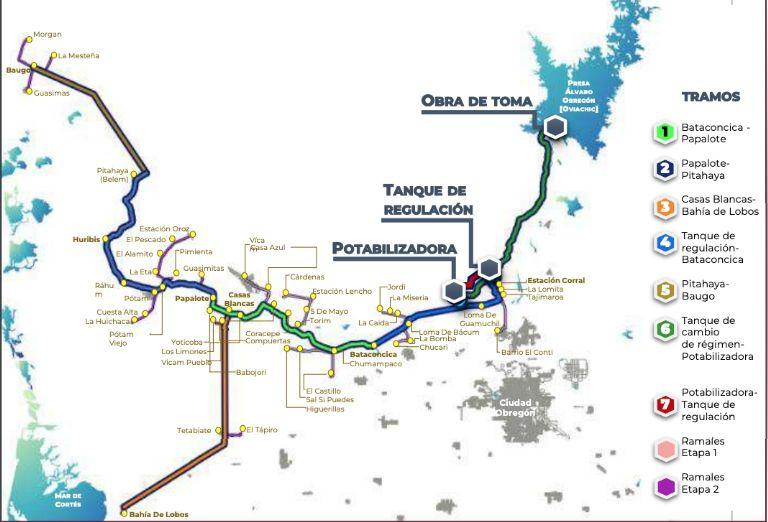
CONAGUA — Río Yaqui–Guaymas Aqueduct Map
How Does the Guaymas–Empalme Desalination Plant Work?
The Guaymas–Empalme seawater desalination plant began operating in July 2022. Located in the municipality of Empalme, it was developed through a public-private partnership involving the Comisión Estatal del Agua (CEA), federal infrastructure financing and private operator Aqualia.
The facility has a design capacity of 200 litres of drinking water per second, equivalent to approximately 17.28 million litres per day when operating continuously at full capacity.
According to Aqualia’s technical description, the process involves:
- Seawater collection: Water is extracted through seven coastal wells near the shoreline.
- Filtration and desalination: Reverse-osmosis membranes remove dissolved salts and other substances.
- Post-treatment: The treated water is conditioned to meet drinking-water requirements.
- Distribution: A pipeline approximately 11 kilometres long carries the treated water to an existing storage and distribution facility serving Guaymas and Empalme.
- Brine disposal: The concentrated saltwater remaining after desalination is handled through a separate discharge system (which raises its own environmental concerns, particularly regarding impacts on marine ecosystems).
The facility also incorporates energy-recovery technology designed to reduce the electricity required for desalination.
Although the plant provides an important additional source of water, it was not designed to replace the region’s groundwater wells and aqueducts. The engineering company involved in the project described its capacity as representing approximately 25 percent of regional water requirements at the time of project development.
Importantly, the plant’s documented service area is Guaymas and Empalme. We have not established that desalinated water is delivered directly to San Carlos.
Is the Desalination Plant Actually Working?
Yes, the plant is operational, but its output has not always been consistent.
In an April 9, 2026 announcement, Aqualia reported production of 200 litres per second and stated that the facility benefited approximately 200,000 residents of Guaymas and Empalme.
However, on September 17, 2026, CEA reported that the desalination system was operating at approximately 50 percent capacity. The problem involved reduced electrical supply affecting the C1 pumping station, where only two pumps were operating.
The disruption was documented in local reporting based on CEA information.
As of November 4, 2026, What’s Up San Carlos has not located a subsequent confirmed production figure establishing whether the system has returned to full output.
There is also a difference between producing drinking water and delivering it reliably to every household. Even when the desalination plant operates at full capacity, failures elsewhere in the distribution system can interrupt service.
Why Do Water Shortages Continue?
The region’s water problems are not caused by any single factor. Government reports and recent service disruptions point to several overlapping challenges.
Aging Pipes and Water Losses
One of the most significant problems is the amount of water lost before it reaches consumers.
In April 2026, Rodolfo Castro Valdez, director of CONAGUA’s Northwest Basin Agency, estimated that approximately 40 percent of water distributed for domestic use in Guaymas was lost through leaks.
At the time, he reported domestic supply of approximately 600 litres per second and emphasized the need to improve the efficiency of existing infrastructure.
The figures, reported by El Vigía, are estimates from April 2026 rather than a current independent audit. Nevertheless, they illustrate the scale of the distribution challenge.
Increasing the amount of water produced does not necessarily solve shortages if substantial quantities are lost through damaged or deteriorating pipes.
Electricity Failures and Damaged Wells
Water delivery depends heavily on electrically powered wells, pumps and pumping stations.
During 2026, heavy rains and electrical outages repeatedly affected this infrastructure.
On October 15, CEA reported that four of the 16 wells supplying Guaymas remained out of service or inaccessible following storm damage. The local administrator reported a reduction of approximately 20 percent in the affected groundwater supply, complicating distribution throughout the city.
FM105’s October 15 report described damaged electrical infrastructure and rural access roads that prevented repair crews from reaching some wells.
Such failures can produce water shortages even when the underlying groundwater sources remain available.
Damaged Pipelines and Pumping Infrastructure
The system also depends on large transmission pipelines and interconnected pumping stations.
For example, repairs to a 24-inch transmission line near Boulevard Manlio Fabio Beltrones temporarily affected San Carlos in September 2026. Other pipeline damage in Guaymas has interrupted service in multiple neighbourhoods.
Repairing a damaged transmission line can restore service, but the network may need additional time to refill storage facilities and recover normal pressure.
Unauthorized Water Extraction
CEA has also raised concerns about illegal connections to the Río Yaqui aqueduct.
In February 2026, CEA technical officials reported unauthorized connections that they said were substantially reducing the amount of water reaching Guaymas.
According to Meganoticias’ reporting, officials identified at least ten suspected illegal connections.
The precise volume of water lost through unauthorized extraction has not been independently verified, but the problem adds another complication to regional supply management.
Groundwater Availability and Saltwater Intrusion
There are also longer-term concerns about the sustainability of groundwater extraction.
CONAGUA’s groundwater assessments identify limited or negative additional water availability in the San José de Guaymas and Valle de Guaymas aquifers. Technical studies have also documented seawater intrusion affecting coastal groundwater resources.
These findings, available through CONAGUA’s groundwater availability records, highlight the importance of managing groundwater extraction and protecting existing resources.
Negative groundwater availability does not mean that every well has run dry. It indicates that further extraction may not be sustainable under the assessed conditions.
What’s Being Done to Improve the Water Supply?
Several infrastructure projects have been undertaken or announced, although their completion status and expected benefits vary.
Water Infrastructure Improvements in the Ranchitos
One substantial project involves the Ranchitos area of San Carlos.
In August 2025, the Guaymas municipality announced the first stage of a water-network rehabilitation project involving approximately 13.97 kilometres of distribution piping, network sectorization and 900 household connections.
The original investment was approximately 12 million pesos, with the project intended to improve service for approximately 1,815 residents.
The municipality has since published a formal project handover record and final contract documentation, providing evidence that this first stage reached the administrative completion process.
These improvements are important, but the published documents do not establish how much they have increased the total water available to San Carlos or whether they have eliminated service interruptions in the affected neighbourhoods.
Additional Municipal Water Infrastructure Investments
Guaymas’ approved 2026 public works program included approximately 10.49 million pesos for hydraulic infrastructure improvements in the urban area and San Carlos, including work on distribution systems and valve boxes.
The municipal announcement identifies planned expenditures, but does not establish that every project has been completed.
In September 2026, the Sonora government also announced approximately 625.7 million pesos for four wastewater-treatment projects in the Guaymas–San Carlos area: Ranchitos, Guaymas Norte, Malecón and La Salada.
These projects are intended to improve sewage treatment and sanitation. Although important for public health and environmental protection, they should not be confused with projects that directly increase the drinking-water supply.
Can San Carlos’ Water Supply Keep Up With New Development?
As new condominiums, subdivisions and hotels continue to appear throughout San Carlos, residents frequently ask an important question: Where will the water come from to support all this growth?
Under Sonora’s regulations, proposed developments are subject to water-service feasibility reviews by the Comisión Estatal del Agua (CEA).
The process considers water availability and existing infrastructure, and developers may be required to construct or finance necessary improvements, obtain approval for water and sewer engineering plans, install water-management equipment and provide storage facilities.
But what does the public record show about projects actually being approved?
Which San Carlos Developments Have Received Water Approvals?
A review of municipal authorizations published in the Sonora Official Bulletin identifies several residential developments that received favourable CEA water-service feasibility determinations.
| Development | CEA determination date | Documented approval |
|---|---|---|
| Vistas del Country Residencial | June 2, 2021 | Favourable water feasibility; separate approval of water and sewer plans |
| Belo Horizonte 2 | May 22, 2023 | Favourable water and sewer feasibility |
| Zafiro–Turquesa | July 7, 2023 | Favourable water feasibility; authorization also references sewer-service feasibility |
| Lomas Altas del Pedregal | September 1, 2023 | Favourable water and sewer feasibility |
| Vistas del Country II | May 14, 2024 | Favourable water and sewer feasibility |
| La Reina II | September 2, 2024 | Favourable potable-water feasibility; developer responsible for wastewater disposal |
| Residencial Bondesier | January 6, 2025 | Favourable potable-water feasibility; developer responsible for wastewater disposal |
These examples are drawn from published municipal authorizations and do not represent a complete list of all San Carlos developments. The dates refer to CEA determinations, not construction commencement or completion.
What About Costessa High Sea Living?
Costessa High Sea Living, the 165-condominium development at Playa San Francisco, has also received municipal authorizations.
Its August 2022 zoning approval lists a CEA feasibility document among the materials submitted for the project.
However, the underlying CEA water determination, including its reference number, approved capacity and any specific infrastructure conditions, has not been located in the publicly available records reviewed.
Costessa’s municipal construction and condominium authorizations are documented, but those records do not by themselves establish how much additional water the project will require or how that demand will be accommodated.
Do These Approvals Guarantee Enough Water?
Not necessarily.
A favourable CEA determination indicates that water service was considered feasible for a particular development under the applicable approval process.
It does not guarantee uninterrupted household service, nor does an individual approval demonstrate that the community as a whole has sufficient water for every existing and proposed development.
The public records also leave several important questions unanswered:
- How much additional water will all approved and proposed developments require?
- Has CEA assessed the combined impact of new development on groundwater resources and the distribution system?
- What infrastructure improvements have developers financed, and what measurable benefits have resulted?
- Have any proposed developments been denied water-service approval or required to reduce their water demands?
- How frequently are feasibility determinations reassessed as development plans and water conditions change?
Although numerous favourable determinations appear in published development authorizations, What’s Up San Carlos has not located a comprehensive public register identifying approved, denied and conditional applications, or a current assessment comparing the cumulative water needs of planned development with available supply.
A New San Carlos Water Planning Council
There has been at least one effort to bring developers and water authorities together to address the problem.
In February 2026, CEA convened local developers and water-system users to establish the Consejo Promotor de Desarrollo Sustentable del Agua de San Carlos.
According to reporting published February 19, the council was created to coordinate infrastructure improvements and develop a proposed investment fund involving developers, government and water users.
Roberto Lemen Meyer was named council president, with CEA administrator César Javier Granich Duarte serving as technical secretary.
The initiative could provide a mechanism for coordinating new development with water infrastructure needs. However, publicly available information has not yet established how much funding has been committed, which projects will be financed, or what improvements have resulted.
The government’s own urban development planning documents have also acknowledged weaknesses in coordinating San Carlos’ growth with water and sewer infrastructure.
The central question remains whether water infrastructure and long-term supply planning are keeping pace with the community’s continued growth.
What Does the Future Hold for Our Water Supply?
The challenges facing San Carlos, Guaymas and Empalme are both immediate and long-term.
In the short term, reliable water delivery depends on maintaining groundwater wells, electrical equipment, pumping stations, transmission pipelines and neighbourhood distribution networks.
Reducing leaks could improve the amount of water available to residents without necessarily requiring an equivalent increase in production.
Over the longer term, the region must address groundwater sustainability, infrastructure modernization and the additional demand created by residential, commercial and tourism development.
The desalination plant provides an important supplementary source, but it does not eliminate the need to maintain existing groundwater infrastructure or improve distribution efficiency.
New investments and coordination efforts may help. However, assessing their effectiveness requires more than announcements about planned spending or approved developments. It requires information about water actually produced, delivered and consumed, together with measurable improvements in service reliability.
Ultimately, the most important question is not simply how much water the region can produce. It is whether enough water can be delivered reliably and sustainably to meet the needs of today’s residents while accommodating future growth.
What’s Up San Carlos will continue following water-supply developments, infrastructure improvements, desalination operations and the impact of new construction, updating this article as significant new information becomes available.
Do you have additional information? We’re particularly interested in learning more about local water sources, infrastructure improvements, and how the water needs of new developments are being addressed. If you have firsthand knowledge, relevant documents or information that could help us build a more complete picture, please get in touch.
Research reviewed November 4, 2026. Operating figures and infrastructure conditions are dated to their reported sources and should not be interpreted as a real-time water-service status report.