





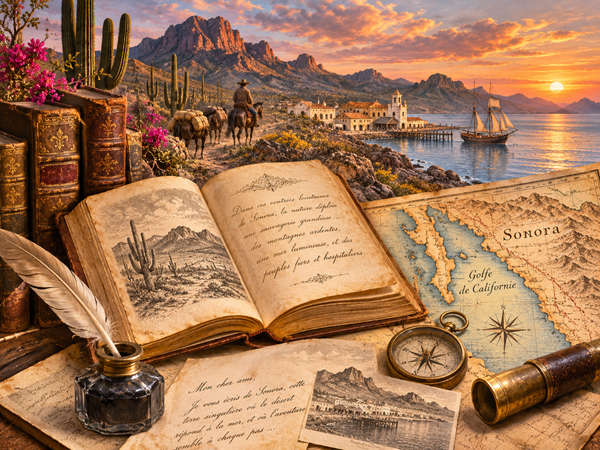
 Long before Hollywood Westerns, French readers were captivated by tales of gold seekers, rugged deserts, frontier adventures and mysterious lands in northwestern Mexico. And one of the places that captured their imagination was Sonora.
In 1846, a French writer named Gabriel Ferry introduced readers of a prestigious Paris literary magazine to the harbour of Guaymas. He described its sheltered waters, whitewashed buildings, towering mountains and spectacular sunsets with the enthusiasm of someone discovering an extraordinary place.
Ferry wasn’t simply imagining these landscapes. He had actually travelled through Guaymas and Sonora, and his experiences would help inspire some of France’s earliest Western-style adventure fiction.
His writings also reveal something fascinating about how Europeans viewed Sonora nearly 180 years ago—a land of extraordinary natural beauty, supposed untold mineral riches and uncertain political borders.
A French Adventurer Arrives in Guaymas
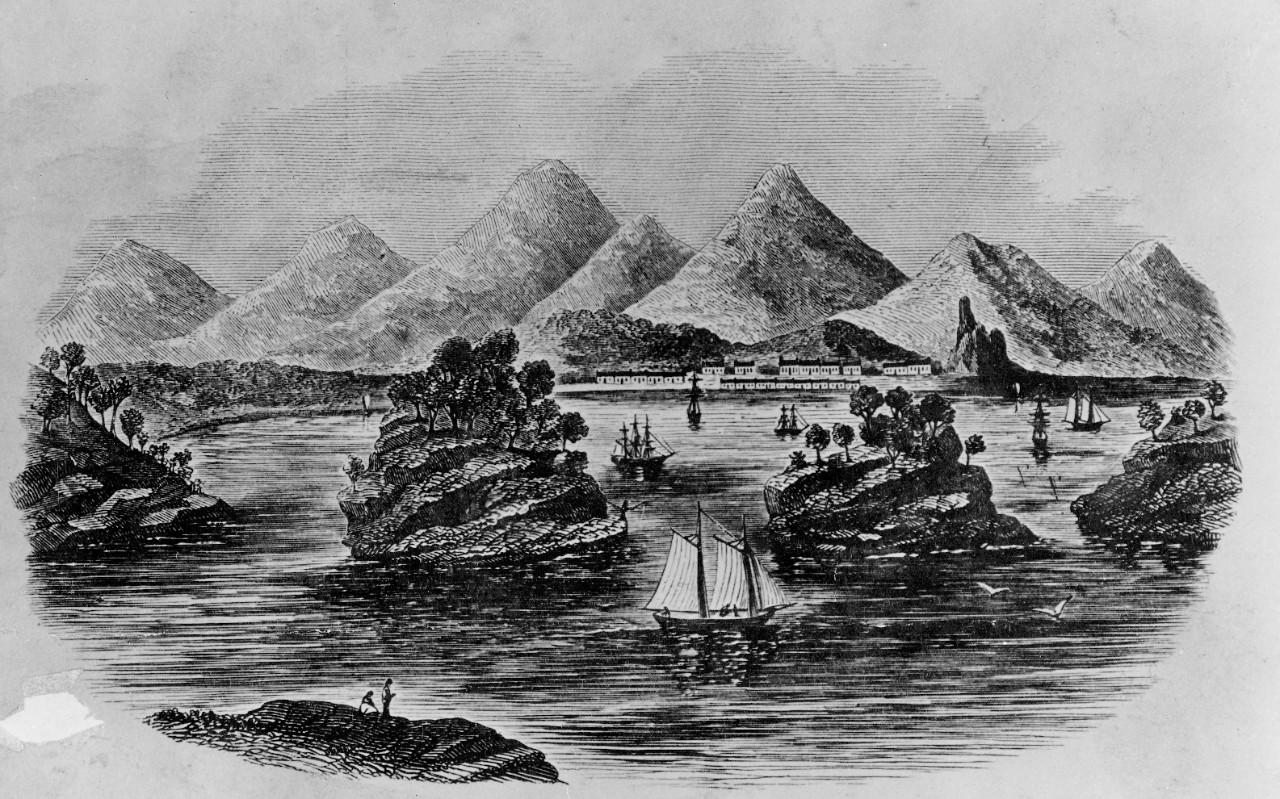
Gabriel Ferry was the pen name of Louis-Eugène-Gabriel de Ferry de Bellemare, born in Grenoble, France, in 1809.
He arrived in Mexico during the 1830s, initially to pursue business interests associated with his family. But the young Frenchman’s fascination with travel and adventure soon took him far beyond the commercial world.
During approximately seven years in Mexico, Ferry explored different regions of the country, gathering experiences that would eventually provide the material for his writing.
One particularly memorable journey took him from San Blas, on Mexico’s Pacific coast, across the Gulf of California and eventually to Guaymas.
From there, he travelled inland through Hermosillo, Arizpe and Bacoachi, continuing north toward Tubac, in what is now Arizona.
His route took him through landscapes that seemed extraordinarily remote to European readers: desert mountains, isolated settlements, mining districts and vast stretches of wilderness.
But it was Guaymas that provided one of his most memorable descriptions.
Guaymas as Seen Through French Eyes in 1846
On June 15, 1846, the French literary journal Revue des Deux Mondes published Ferry’s account, Une guerre en Sonora (A War in Sonora), part of a series describing his experiences along Mexico’s Pacific coast.
His description of Guaymas is remarkably vivid.
Ferry compared its sheltered harbour to a tranquil lake, protected from powerful Gulf winds by the surrounding coastline and islands.
He described mangroves lining the shore, their pale green foliage contrasting with the ochre-coloured ground. Small coastal vessels and canoes shared the anchorage with larger ships flying French, American and British flags near Venado Island.
Seen from the water, Guaymas appeared as a collection of low white buildings against steep, rugged mountains. From the surrounding hills, however, the view became something more spectacular.
At sunset, Ferry described the mountains taking on violet tones while pink clouds and the fading sunlight transformed the waters of the Gulf of California into shades of red and blue.
His descriptions also included seabirds, sea lions and even whales rising from the water.
Readers familiar with Guaymas and San Carlos today might recognize some of those same natural features—the rugged coastal mountains, sheltered bays and dramatic colours of the desert meeting the sea.
You can read Ferry’s original 1846 account of Guaymas in French.
An Outsider’s Prediction About Guaymas
In the same 1846 account, Ferry made a striking political prediction. Comparing Sonora with Texas, which had recently joined the United States, he speculated that American territorial expansion would eventually reach Sonora, turning Guaymas into a U.S. port on the Pacific.
His remarks reflected the expansionist pressures of the era. Published during the opening months of the Mexican–American War, they also reveal how foreign observers sometimes viewed Mexican territory in terms of its strategic and commercial value, with little consideration for Mexican sovereignty.
Ferry’s prediction never came true. Sonora remained part of Mexico, but his words offer a revealing glimpse into the geopolitical ambitions and assumptions of the mid-19th century.
From Real Adventures to French Westerns
Ferry’s journeys through Sonora provided more than descriptions of beautiful scenery. They supplied characters, encounters and experiences that eventually found their way into his fiction.
According to historian Juan Domingo Vidargas del Moral, writing for the National Autonomous University of Mexico (UNAM), Ferry encountered a French-speaking Canadian hunter dressed in animal skins while travelling through northern Sonora.
The unusual meeting apparently made such an impression that the hunter became a model for a principal character in Ferry’s later novel, Le Coureur des bois, ou les chercheurs d’or (The Woods Runner, or the Gold Seekers).
Ferry also observed gold-mining operations near Bacoachi, visited remote haciendas and witnessed the skills of local horsemen.
These experiences helped shape his fictional world of prospectors, wilderness travellers, ranchers and frontier adventures.
Beginning in 1846, Ferry published stories about northwestern Mexico in Revue des Deux Mondes, including Une guerre en Sonora, L’Île du Tiburon (Tiburón Island) and Les Gambusinos (The Prospectors).
His better-known novel, Le Coureur des bois, circulated around 1850, with documented book editions appearing in 1853.
Literary scholars sometimes describe it as the first French Western, although that classification is debated. Influenced by the frontier novels of American author James Fenimore Cooper, Ferry helped establish a tradition of French-language adventure fiction featuring the landscapes and conflicts of North America.
And unlike some later writers who imagined these distant places entirely from Europe, Ferry could draw on his own experiences in Mexico.
His life ended unexpectedly in 1852. Having been appointed to a French consular position in San Francisco, he died when the ship carrying him toward California caught fire at sea.
He was just 43 years old.
Sonora: A Land of Gold and Adventure in the French Imagination
Ferry wasn’t the only French writer fascinated by Sonora.
During the 19th century, several French novelists used the region as a setting for stories filled with prospectors, outlaws, dangerous journeys and the pursuit of fabulous wealth.
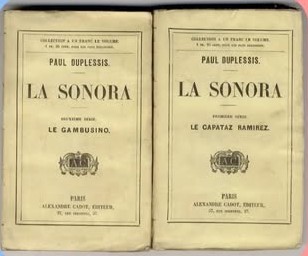
Paul Duplessis wrote La Sonora, featuring volumes titled Le Gambusino (The Prospector) and Le Capataz Ramírez (Foreman Ramírez). Although its title refers to Sonora, some of the fictional geography corresponds to areas of present-day Sinaloa.
Another popular adventure writer, Gustave Aimard, published Les Trappeurs de l’Arkansas (The Trappers of Arkansas) in 1858 and later incorporated Sonoran settings and mining themes into his fiction.
Why were French authors so interested in this distant corner of Mexico?
One major reason was gold.
Sonora had long been associated with rich deposits of gold and silver. Reports of mineral discoveries, together with the California Gold Rush of 1848–1849, fuelled European speculation about the wealth supposedly waiting to be discovered in northwestern Mexico.
Some writers portrayed Sonora as an almost mythical land of riches, where fortunes could be made by adventurous prospectors.
Historian Ana Rosa Suárez Argüello, in her study Sonora y los viajeros franceses entre 1824 y 1863, explains how travellers, businessmen and novelists helped spread this image of Sonora as a potential El Dorado.
The fascination wasn’t confined to literature.
In 1854, French adventurer Count Gaston de Raousset-Boulbon attempted to seize Guaymas with an armed expedition. Mexican soldiers and local volunteers, led by General José María Yáñez, defeated his forces on July 13, an event still commemorated as the Heroic Defense of Guaymas.
Although the adventure novels cannot be said to have caused such expeditions, both the fiction and the military ambitions reflected a broader French interest in Sonora’s resources and strategic location.
More Than Just Adventure Novels
The French literary connection to Sonora was surprisingly extensive.
According to research by Ernesto López Yescas, cited by Sonoran literary researcher Josué Barrera, approximately 38 French authors wrote specifically about Sonora during the 19th century.
Not all were novelists. Their works included historical accounts, travel narratives, mining studies, geographical descriptions and writings about the region’s Indigenous communities.
These books offer a fascinating window into how Europeans understood—or sometimes misunderstood—Sonora.
They also need to be read with a critical eye. Many of the authors viewed Indigenous peoples through European colonial stereotypes, exaggerated the region’s mineral wealth or blended actual events with fictional adventures.
Nevertheless, their writings preserve descriptions of places, landscapes and encounters that might otherwise be forgotten.
Rediscovering a Forgotten Literary Connection
Nearly two centuries later, these books offer an unexpected perspective on Sonora’s place in world literature.
The Guaymas that Gabriel Ferry encountered in the 1830s was very different from today’s busy port city. Yet some of the things that captivated him—its natural harbour, rugged mountains, colourful sunsets and the extraordinary meeting of desert and sea—remain familiar.
For French readers in the 1840s and 1850s, Sonora was a distant and mysterious frontier, a setting for romantic adventures and dreams of gold.
For those of us who know the region today, these stories provide something different: a chance to see a familiar landscape through the eyes of travellers and writers who encountered it nearly 180 years ago.
And it’s remarkable to think that long before the American Western became a fixture of popular culture, the mountains, deserts and mining settlements of Sonora were already inspiring adventure stories on the other side of the Atlantic.
Explore the Original Books and Historical Research
Interested in discovering what French readers were learning about Sonora in the 19th century?
Une guerre en Sonora — Gabriel Ferry (1846)
Read Ferry’s original French account, including his descriptions of Guaymas and his prediction about the region’s future.
Le Coureur des bois — Gabriel Ferry
Read a digitized later edition of Ferry’s adventure novel in its original French.
The First Frenchman in Northwestern Mexico — UNAM Historical Study
A detailed historical examination of Ferry’s travels and writing by Juan Domingo Vidargas del Moral.
Sonora in French Literature — Josué Barrera
A Spanish-language overview of French novelists who wrote about Sonora.
Sonora and French Travellers, 1824–1863
Academic research by Ana Rosa Suárez Argüello exploring French interest in Sonora’s supposed mineral riches.