





Hermosillo is emerging as an important centre for clean-energy innovation in Sonora, combining electric municipal vehicles, solar-power projects and new technology initiatives with efforts to attract investment and create skilled jobs.
The city hosted the World Solar Energy Forum from October 21–23, 2026, bringing together international experts, business leaders and government representatives to discuss renewable energy, electric transportation and sustainable development.
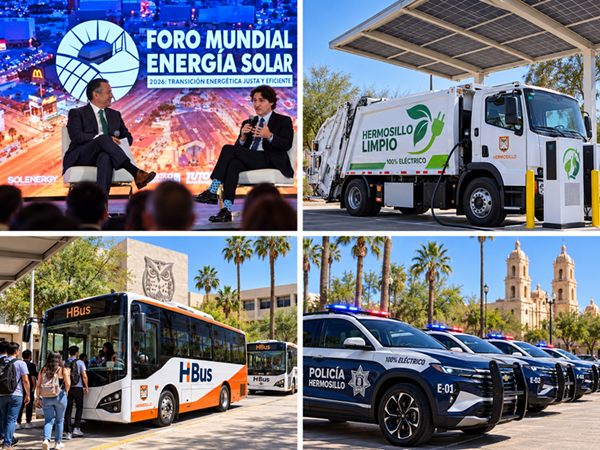
Former Canadian Prime Minister Justin Trudeau participated on October 21 in a discussion moderated by Hermosillo Mayor Antonio Astiazarán. Trudeau praised the city’s investment in electric vehicles and solar technology, emphasizing the economic as well as environmental benefits of adopting renewable energy.
But Hermosillo’s clean-energy ambitions extend well beyond international conferences.
Electric Garbage Trucks and Municipal Vehicles
In August 2025, Hermosillo introduced 25 fully electric garbage trucks, supported by 13 charging stations and 245 solar panels.
The municipality projected that the new fleet would save approximately 22 million pesos annually in fuel and maintenance costs, potentially freeing up resources for other public services.
Electric vehicles are also becoming a significant part of the city’s public-safety operations.
By September 2026, Hermosillo reported a fleet of more than 350 electric police patrol vehicles. Five electric pickup trucks were also added to the municipal Civil Protection department in August.
According to city officials, more than one-third of Hermosillo’s municipal vehicle fleet of over 1,300 units now operates on electricity.
Free Electric Transportation for Students
Hermosillo has also introduced HBus, a free electric-bus service designed to help university students travel between residential neighbourhoods and educational institutions.
In 2025, the program reported serving approximately 1,600 students across nine routes.
The service has continued to develop. In September 2026, the city strengthened evening operations to accommodate increased demand, particularly among students attending evening classes.
The program illustrates how electric transportation can address everyday challenges, including transportation costs and access to education.
Solar Power and a Long-Term Energy Strategy
Hermosillo’s ambitions extend beyond transportation.
Its Municipal Energy Transition Strategy for 2024–2030 includes 25 strategic programs and 80 indicators intended to promote renewable energy, improve efficiency and encourage sustainable development.
Initiatives include residential solar installations and financing programs designed to help smaller businesses adopt solar-power systems.
In May 2026, municipal officials reported that the Hogar Solar program had installed 228 residential photovoltaic systems between 2021 and 2023. The Impulso Solar initiative also has financing support through Nacional Financiera.
The municipality’s longer-term plans include reducing greenhouse-gas emissions and encouraging energy-efficient construction.
Developing Sonora’s Electric-Vehicle Industry
Innovation is also taking place at the Instituto Tecnológico de Hermosillo, where students and researchers are developing electric-vehicle technology.
In June 2026, students presented a functional prototype of a compact electric vehicle through the AVIDO project, developed in cooperation with Automax.
The achievement demonstrates growing technical capabilities in Sonora, although turning prototypes into commercially viable vehicles will require further development, investment and manufacturing capacity.
What Does This Mean for Guaymas and the Rest of Sonora?
Hermosillo is not the only community participating in Sonora’s clean-energy transition.
Near Guaymas, the Bluemex Power 1 solar facility in Empalme has been generating electricity since 2019, with approximately 120 MW of peak solar capacity.
In June 2026, the Universidad Tecnológica de Guaymas signed a collaboration agreement with EDF Power Solutions, creating opportunities for students to gain practical experience and professional training associated with renewable-energy operations.
Meanwhile, Sonora officials have identified Guaymas as one of the municipalities requiring improvements to electricity infrastructure to accommodate industrial, commercial and residential growth.
These developments are separate from Hermosillo’s municipal programs, but they illustrate how clean-energy investment, education and infrastructure are becoming connected across the region.
For San Carlos and Guaymas, the opportunities may eventually extend to employment, training, business development and improved infrastructure. The scale and timing of those benefits remain to be seen.
From Ambition to Results
Hermosillo has demonstrated that electric vehicles and solar technology can be incorporated into everyday municipal services.
The next challenge is measuring the longer-term results: whether projected financial savings are realized, how much emissions are reduced, and whether these initiatives generate lasting businesses, investment and skilled jobs.
For Sonora, the city’s experience provides an example of how clean-energy ambitions can begin with practical changes to the services residents use every day.
Information reviewed November 4, 2026.